

Micke har varit en drivande kraft inom Unga Örnar i hela 38 år. Hans resa började oväntat på ett disco under 80-talet, och idag är han en engagerad ledare som lägger flera dagar i veckan på att skapa en meningsfull verksamhet för barn och unga.
”Jag kom i kontakt med Unga Örnar tack vare en kompis som bjöd med mig till ett disco de arrangerade. Det var en rolig kväll, och efter det blev jag medlem. Jag har varit med ända sedan dess,” berättar han med ett leende.
Med åren växte engagemanget, och han inspirerades av andra ledare att själv ta på sig en större roll i organisationen.
”De var positiva förebilder, och jag såg hur kul och lärorikt det verkade att få vara med och utveckla verksamheten.”
Idag spelar Unga Örnar en central roll i hans liv. Han har aktiviteter tre gånger i veckan och är dessutom engagerad i distriktsstyrelsen.
”Det är inte bara en hobby, det är en del av mitt liv.”
För Micke handlar Unga Örnars arbete i grunden om att kämpa för barns rättigheter.
”Det är grunden till allt vi gör. Det handlar om att skapa en trygg plats där alla barn får leka, utvecklas och känna sig inkluderade – oavsett bakgrund.”
Under sina år som ledare har han varit med och drivit många projekt. Bland de som sticker ut finns en rockmusikskola i Vivalla och en populär LAN-verksamhet som engagerade unga i flera år.
”Jag är också väldigt stolt över den verksamhet jag leder idag. Det är fantastiskt att få se vad vi kan åstadkomma tillsammans med barnen.”
Ett särskilt minne har etsat sig fast och påverkat honom starkt som ledare.
”Det var ett barn som ville bli medlem men inte hade råd. Hen började samla pant och kom tillbaka efter tre veckor med pengar till medlemsavgiften. Det visade mig hur viktigt vårt arbete är och att vi måste fortsätta kämpa för barns rätt till lek och fritid.”
Trots framgångarna finns det utmaningar. En av de största är att få fler vuxna att engagera sig ideellt.
”Om fler kunde ställa upp en eller två timmar i veckan skulle vi kunna nå fler barn och skapa ännu större trygghet.”
Han ser också ekonomiska hinder för barn i vissa områden, där medlemsavgifter kan vara en tröskel.
”Jag tycker att Unga Örnar kan arbeta mer politiskt för att se till att alla barn får möjlighet att delta i föreningslivet, oavsett ekonomi.”
När Micke beskriver Unga Örnar för någon som aldrig hört talas om organisationen, är han tydlig.
”Det är världens bästa barn- och ungdomsorganisation! Här får alla vara med och skapa, påverka och utveckla verksamheten. Och vi arbetar hela tiden utifrån barnkonventionen. Alla är lika mycket värda här.”
Trots sina 38 år i organisationen är han fortfarande lika motiverad.
”Det som driver mig är att se hur viktigt Unga Örnar är för barn och unga. Det handlar om att ge dem en trygg plats, en stark värdegrund och fantastiska minnen.”
Han hoppas på en framtid där Unga Örnar kan fortsätta växa, med fler samarbeten och ett ännu starkare fokus på barns rättigheter.
”Vi har kommit långt, men det finns alltid mer att göra.”
Med sitt starka engagemang och sin långa erfarenhet är Micke ett levande bevis på hur ideellt arbete kan göra skillnad, inte bara för barn och unga, utan också för samhället i stort.
In the heart of Jerusalem, the organization Old City Youth Association (OCYA) works to create a safer, peaceful and more meaningful daily life for children and young people. Through collaboration with international actors such as the Olof Palme International Center (OPC) and Swedish organizations like ABF, they have been able to develop their activities and facilitate exchanges that provide youth with new perspectives.
We met Riad Shihabi and Semeer Amro, who work with the organization, to gain insight into their efforts and the challenges they face.
The Old City Youth Association has existed since 1990 and focuses on three main target groups: women, children, and youth. Their activities range from digital activities, summer camps and festivals to daily workshops and training sessions on democracy, gender equality, and human rights.
OCYA has been involved in international collaborations for many years and has previously worked with ABF Botkyrka/Salem.
”We have had youth exchanges between Jerusalem and Sweden for several years, focusing on issues such as gender, democracy, and racism. It has been incredibly valuable for our young people to experience a different world and see how different societies function,” says Shihabi.
The organization has grown significantly over the years, but not without difficulties. Semeer Amro, the organization’s manager, explains that financial conditions have often been fragile and dependent on short-term funding.
”We have worked to build a stable organization, from acquiring computers to training our leaders in democracy and organizational development. The collaboration with OPC and Swedish partners has been crucial in creating a long-term strategy.”
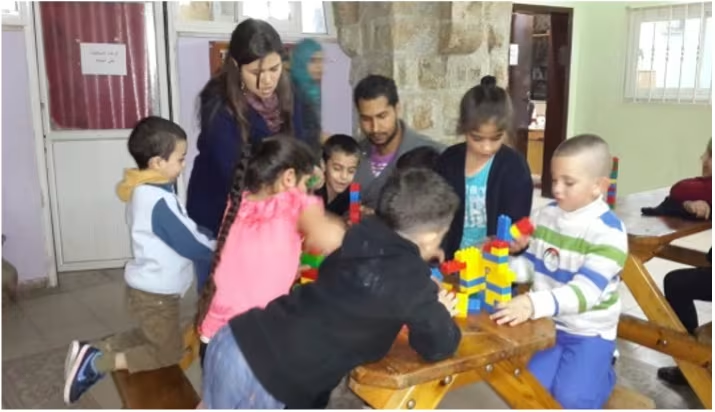
Life for children and youth in Jerusalem is shaped by political and social challenges. Human rights are constantly under threat, and many children have limited access to education and recreational activities.
”In Jerusalem, we have a young population, but the necessary conditions are lacking. Only 10% of children attend preschool, and there are very few safe and meaningful activities available. Many children are forced to work from an early age to help support their families,” says Amro.
Beyond financial difficulties, children and youth live under a constant threat from authorities and the occupying power. They can be stopped on the street, searched, and subjected to violence. Infrastructure for leisure activities is completely lacking in some areas, in the Palestinian part of Jerusalem, there is not a single football field, while on the Israeli side, there are thousands.
”What should children and young people believe about the future when they grow up in such a situation? They see that they lack opportunities, live under threat and that they don’t have access to a good education, and that even if they do get an education, they won’t be able to find a job. Those who succeed often leave Jerusalem to build a future elsewhere,” says Amro.
Women are in an especially vulnerable situation. They not only face the general challenges of occupation and restricted movement but also structural barriers within society. Women have less access to education and jobs, and many live in economic and social hardship.
”We see that women are often denied basic rights and opportunities. We actively work to create spaces where they can organize, have workshops, and build their lives despite the limitations they face,” says Aamro.
Despite the challenges, there is a strong determination to create change. Through international collaborations such as the one they hope to establish with Unga Örnar. Young people gain the opportunity to see and experience other cultures and societies.
”These exchanges have been incredibly important. They give young people the opportunity to share their own stories and see how other youth live. They see that their religion and culture are respected in Sweden, which has led to more interest in participating in exchanges.” says Amro.
Looking ahead, the focus remains on continuing to create opportunities for youth and women, despite the existing limitations.
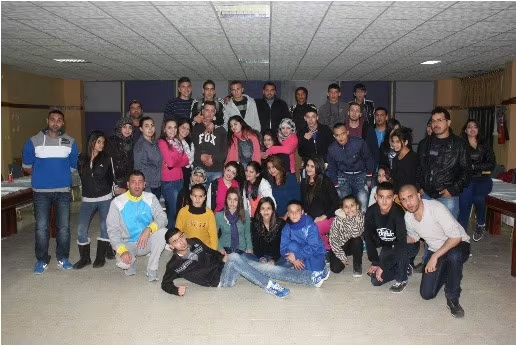
”Our goal is for children and youth to have a better future. We want them to grow up in peace, work together, and build their city. It’s a long road ahead, but through local and international collaborations, we can take small steps toward change,” concludes Shihabi.
Despite the difficulties, there is a clear determination to change the future for Jerusalem’s youth and women. Through collaboration, education, and cultural exchanges, hope is kept alive, a hope for a more just and peaceful future for all.